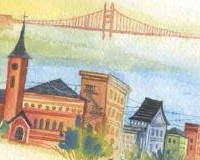
Together at Last!

I am always amazed to hear stories of authors and illustrators who never connect during the picture book process. How can this be? I know publishers can be a bit leery of any author-illustrator relationship pre-publication. After all the author might attempt to influence the illustrator, or squash her creativity. But I LOVE to find my illustrator on social media right away. If the chance arises to meet her in person, all the better. And the ultimate meet up? You got it! A book signing together. 

Chronicle Books was the perfect matchmaker when they paired illustrator, Alina Chau, with my story Double Happiness. Besides being uber-talented, she’s delightful and humble and fun. While I’ve known this for some time, this summer was the first time I was able to see her in action at our signings in California.

First, we visited Luan Stauss’ Laurel Bookstore in Oakland. Alina’s dog, Coco, joined us. When you’re reading Double Happiness, see if you can find Coco in the book.AlinaandNancyatLaurel

PanelatLaurel
Photo by Selina Liu


We had a few celebrities join us at our signings, too. Here’s Mike Jung and his famous donuts: 

MikeJungatLaurel

The next weekend we were privileged to be part of an inaugural event thanks to the Book Shop West Portal and West Portal branch of the San Francisco Public Library. Alina and I read Double Happiness in two voices (Gracie’s and Jake’s) at the library. Alina showed the audience how to draw a few of the characters.

Characters2

We had a celebrity there, too–the lovely Deborah Underwood.DeborahUnderwoodWestPortal

 Our last stop was a totally new venue for me. Trickter is a gallery/bookstore in Berkeley, run by Anita Coulter. 

AlinaNancyAnitaSee what happens when you hang with your illustrator! A whole new world opens before you. 

Now if I can only entice Alina to visit the east coast for a few double signings here. That will be extra happy occasion, for sure. 

(As an aside, I had the best fig pizza ever from Summer Kitchen in Berkeley, but I didn’t get to try Mike’s donuts)

THE Book Syndrome

Confession time, my fellow authors. You, too, must have experienced what I call “THE Book” Syndrome. Yes? Please tell me so! It happens when someone else’s story is published at the same time as your book, but THE Book is far more flashy, in a golden orbish kind of way. It gets all the attention and you’re curious why, so you check it out. In your heightened state of jealousy, you give it a whirl. And after you read it cover to cover, you’re still puzzled. Say what? Yet THE Book follows you everywhere. You pick up a magazine at the gym or at your hairdresser’s, and there it is. You go to your library, and it’s on prominent display. Kids are reading THE Book in the middle of the park (Okay, slight exaggeration). But the final straw is when you do a signing yourself. It’s your big day. Readers are excited about your book. And when you’re finished, the event planner hands you just one book as a “Thank you!” for your participation. And guess which book it is? Yup, It’s THE Book! And you take it home and reread it and think, “Okay, maybe it’s worthy of a bit of that glory and glitter. Maybe just a little.”

custom image

Off and Running

Ahh, the lazy days of summer are fading. Sigh. Still, that means Double Happiness is definitely on the scene. With its book birthday on August 8th, I decided to wait until folks returned from the beach for some book signings. If you care to mark your calendars, here are some upcoming events:

September 11th, 7 pm, at The Writer’s Loft, for a Book Bash. Lots of wonderful authors, including the New York Times Bestseller, Lynda Mullaly Hunt. Click Here for Details:

September 26th, 11 am, at The Blue Bunny, Double Happiness has a launch party, including a reading, a craft and, yes, snacks and dragons. Don’t they always go hand in hand. Click Here for Details:

October 24th, 11 am, at Wellesley Books. Join me and some fabulous picture book authors (Josh Funk, Anna Staniszewski, Jane Sutcliffe and Ammi-Joan Paquette) for readings and crafts. Click Here for Details:

November 5th, 10:30, at An Unlikely Story. Come listen to the story of Double Happiness and then make your own happiness box. 

Why Double Happiness?

SanFranDHAt some point in your life you may have come across the Chinese characters that mean “double happiness.” To make this symbol, the character for “happy” is basically repeated, so you have “happy happy” next to one another, creating an extra joyful effect. It might look traditional like this. TraditionalDHCharacterOr more modern or simplified like this. ModernDoubleHappyCharacter
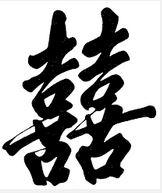
And while this explanation appears quite simple, there’s a heap of tradition behind the concept of “double happiness.”

Traditionally, “double happiness” is found at Chinese weddings on the invitations, hanging on the walls, imprinted on the napkins. After all weddings are happy occasions. In the past, calligraphers would paint the characters, each one made artistically in red or black ink. Now, to save time, they are printed or stamped.

But how, you might ask, does all of this relate to a children’s book with the same name? Believe it or not, my idea for Double Happiness began as a “rainy day” story. I imagined the two main characters, a brother and sister, being typical kids who are bored out of their minds on a rainy day. Their father is trying to fix a leak in their ceiling, so he instructs Gracie and Jake to find two boxes and fill them with treasures they discover around their home. This is his desperate attempt to keep them busy. Being Asian-American father, he calls them “double happiness” boxes.

Turns out, that idea wasn’t too appealing to editors. The story “needed more movement.” So I thought, why not a real move? Gracie and Jake could be moving from the west coast to the east coast. Why not? To deal with this hugely traumatic event, Gracie and Jake’s wise grandmother (Nai Nai) hand them each a box with the instructions to collect four treasures each along the way. Jake imagines he is like a dragon, searching for the best treasure. And in many ways, Gracie is like the phoenix, who handles this change in her life with grace. Ahh. See, it was all coming together now.

Wait, you say! Where did this phoenix and dragon come from? Wasn’t it hard enough to learn about “double happiness?”  Well, like the yin and yang of life, (when opposites complement one another), the phoenix and the dragon blend together nicely in Chinese tradition. The dragon represents power and strength. He was the symbol used by the emperors of old. The phoenix represents grace and wisdom. She was used by the empresses of old. Together they create a whole, and so they often appear next to the “double happiness” character at weddings.

Perhaps Kirkus Review said it best:  “Double happiness, traditionally a wish for newlyweds in Chinese culture, expands to key moments here: for sister and brother, for two memory boxes, and step by step, for a former home to a new one.” Well now, I couldn’t have said it better myself. Sometimes we have to put a bit of effort into finding happiness, just as Gracie and Jake do, but it’s worth the journey. Sometimes we end up being doubly happy along the way.

First Line Favorites

TrainofSmallMercies

“Every morning Ellie West listened to her son get out of bed.” This is how The Train of Small Mercies by David Rowell begins. And this is how my new segment about First Line Favorites begins as well. After all, what’s not to love about first lines?

While sounding casual, Rowell deftly pulls the reader into a time in American history when everyday lives were affected by an extraordinary event–Senator Robert Kennedy’s funeral train journeying from New York to Washington, DC. His first line hooks the reader by raising a question. Why? Why is Ellie listening to her son getting out of bed every morning?

The sentence that follows intensifies that question:  “With her husband, Joe, not yet awake, she tuned in so intently to the sounds two rooms down that she could feel some part of her leaving their bed and drifting down the hall.” Now the reader wants to know how old Ellie’s son is, and why she is so attuned to her son’s morning risings? 

As it turns out, Ellie’s son, Jamie, is a Vietnam veteran who’s returned home after losing his leg in battle. And Jamie is just one of the myriad of characters whose day will be forever changed by the passing of Kennedy’s train through their lives. One thing’s for sure, Rowell had this reader hooked from the start.

A Not-to-Miss Workshop

Even if you visit schools as an author/ illustrator already, even if you have a few tricks up your sleeve, I would highly recommend the “Author School Visits” workshop with Michelle Cusolito and Marty Kelley. They discussed contracts and pricing, marketing and presentations (not to mention a burp and a boogie tossed in by Marty here and there). It was fabulous! Don’t miss it, if and when they offer this workshop again. 

The Blue Bunny, Celebrating Independent Bookstore Day

Thinking back on this fun day, May 2nd, at the Blue Bunny Bookstore in Dedham. 

National Independent Bookstore Day
The nine regional independent bookseller associations across the country are working together to collaboratively support a national Independent Bookstore Day on May 2, 2015.  With assistance from their regional associations, bookstores from coast to coast will be welcoming customers in for entertainment, goodies, and specially created literary items.  The Blue Bunny will be participating with the following special programs:

  • 11-noon:  Author Nancy Tupper Ling will be visiting to “toast” Independent Bookstore Day with her book TOASTS.
  • 11-2 pm: Blue Bunny proprietors and authors Peter H. Reynolds and Paul A. Reynolds will be operating a video-booth for IBD customers to give a one-minute pitch for their favorite books.
  • 2-3 pm: Local folksinger Tom Smith will be on-hand for free stories and songs to celebrate the day.
  • All day: Limited edition merchandise, special for Independent Bookstore Day, including a new Peter Reynolds print, will be available.
  • All day: Launch of a Blue Bunny scavenger hunt game that will run through the month of May.
  • All day: Refreshments and special prizes.

Starting Your Own Book Club

At first it might seem intimidating—the idea of starting a book club. After all, there’s a lot to think about, and so many books available to read. Where does one begin?

As you begin to narrow down your options, you may discover this is the perfect time to organize a club of your own. With four book clubs under my belt, I believe I’m starting to get the hang of it now. That said, each group is as different as the people and the books that come to the table.

Keeping these seven questions in mind when forming a book club of your own might prove to be beneficial:

1.      Why start a book club?
It’s essential to answer this question before you work out all the other details.  Initially, there is quite a bit of work that goes into organizing your group. Take a moment to ask yourself how important this venture is to you and why. What do you hope to gain from this endeavor?  Of course sharing a love of books is the main reason why most people start a book club. Likewise it’s a way to grow a community, bringing people closer around a theme or book. This is the reason I started two book clubs at different housing facilities in town—with the hope that a community would come together around a book discussion. So far, so good.

2.      Who to invite?
This relates back to the first question. If you know the purpose of your book club, you’ll know the people to invite. Perhaps it’s a “come one, come all” group. My Senior Center group is this type of club; it is open to the community. As long as the participant picks up the book from the library ahead of time, she can drop in and join the conversation. On the other hand a small group might be your preference. After the birth of my first daughter, I craved adult conversation, so I reached out to some mothers in my church. We ended up with a group of 8-10 to start. If you plan to keep your group intimate however, you might decide to close off membership at some point.

3.      Whether to name your group?
This might seem like a silly idea, but some groups like to have a distinct identity. According to www.readinggroupchoices.com, people use a lot of creativity when naming their book groups. Better Than Therapy Book Club and It’s Not Just About the Food Book Club are a few sample titles. Then there’s Marmaladies, Litwits, Book Broads and John (poor John), and the one I’d jump at . . .Wine, Chocolate & Books. How’s that for the perfect combination?
 
4.      When to meet?
This depends upon a few factors. How strong are your readers? Can they breeze through a 300 page book in no time? Are they retired, so they have mornings free every other week? The key is to survey the group to see what works best. Ultimately it comes down to what works for the leader and the majority of the members. It’s possible that you may lose a reader or two along the way because the meeting time is no longer feasible for her. In this case you can decide whether to have a “once a member, always a member” policy, in the event that someone wants to return in the future (i.e. when her child actually sleeps through the night).
 
5.      Where to meet?
Often times you can use a library room for free, if you sign up ahead of time. There’s also your local church, synagogue, café or bookstore, if you prefer to keep the meeting in a public place. This is best for an open group. For closed groups, where all of the members are friendly with one another, there is nothing like a home meeting. Your choice may depend upon whether you want to serve refreshments.
 
6.      Who will run the meetings?
In many ways it helps the meetings to run smoothly when one person is in charge of facilitating the discussion questions. If you started the book club, you should feel free to take on the role of a leader. This means that you can step in when there are gaps in the conversation, but if the conversation is flowing naturally, don’t interrupt. The trickiest part of being a leader is the handling of difficult personalities. Also, there may be one or two people who dominate the conversation. The art of leading book club is making sure everyone who wants to gets a chance to share.
 
7.      How to choose your book titles?
So many books, so little time. Anyone who is an avid reader faces this dilemma. Which books to choose? After running several book clubs, I have come to the conclusion that some books are best when read alone, while others must be shared. A good mystery may be a great read, but it might not lead to a valuable discussion once you know “Who Done It.” Typically I search for books that are well-written, but they may have been overlooked in the shuffle. For several of my book clubs, I’m unable to use the hottest sellers because twenty copies won’t be available through interlibrary loan. To generate a book discussion, I’d recommend the following resources: the author’s website, the publisher’s website, Books and Authors and NoveList (databases through www.norwoodlibrary.org), litlovers.com, bookclubgirl.com, readinggroupchoices.com, and goodreads.com
           
Keep in mind the best book club involves preparation, participation and a good sense of humor. Or course chocolate helps, too! 
            
Here’s a few fun book titles to go along with your book club:
The book club cookbook : recipes and food from your book club’s favorite books and authors / Judy Gelman and Vicki Levy Krupp
 
Off the beaten page : the best trips for lit lovers, book clubs, and girls on getaways / Terri Peterson Smith